Walking, Paddling, Climbing and sometimes Swimming: Condition for Education for children in many countries…
This post is also available in:

When I visited the United States for the first time, I was impressed by the sight of these big yellow buses, driving early morning around cities, and picking up kids to drop them to public schools. It was a beautiful sight for me to see, mainly because in many countries I have known in Sub Saharan Africa, transportation to school is a luxury.
It is no longer news that Education is one of the biggest (if not the biggest) challenge faced by humanity nowadays, even bigger with the impact of Covid. Low-income countries around the world are struggling to catch up on years and years of numerous difficulties and weaknesses in their education system, worsened by conflict, poverty and affecting access to education and quality of education, which in turn affects the capacity of youth to find jobs, or earn a decent revenue: an endless cycle for poor populations.
One of the numerous challenges in Education we would like to zoom on in this issue of Voice, is Transportation to school.
Make no mistake, in all countries around the world, from the high-income ones to the poorest, transportation to school is affecting kids from low-income households, at various degrees. 
While in the US for example, more than half of school children ride the school bus to school, in many developing countries around the world, walking is the most common way children get to school.
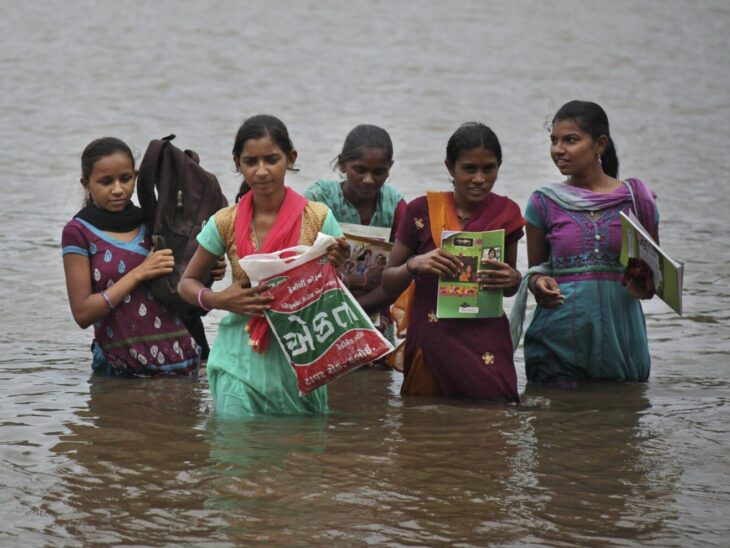
In many rural areas in sub-Saharan Africa or Asia, children are forced to wade through rivers swimming or using archaically made paddle boats, climb mountains, use horse or donkey-drawn carts, walk through forests, swim in unsafe rivers, cross dangerous roads, use a local taxi for part of their journey or engage in other unsafe travel in order to get to school.
You can imagine that in those areas, it is not an option for parents to let their little girls engage in such unsafe travel, therefore not allowing them to attend school in these conditions.
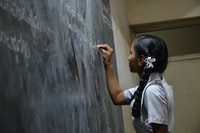
It is either that, or cultural norms that prevent girls living in rural areas in many developing economies to have a chance for education.
In villages around Grand-Bereby, in the South-West of Cote d’Ivoire, children from villages surrounded by rivers on one side, and the sea on the other side, have to wake up around 4am, paddle a boat, walk about 2 or 3 kilometers while crossing rubber tree farms or forests before getting to school, a very dangerous 2 to 3-hours journey every day, especially for girls.
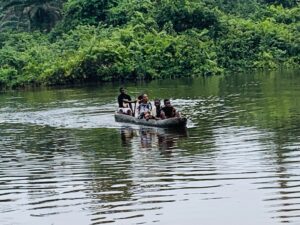 No wonder 72.3% of high-school-aged youth in rural areas are out-of-school compared to boys (28%) as reported by an ILO report on the state of skills in Cote d’Ivoire. This percentage includes 50% of girls aged +15 and only 25% of boys aged +15.
A study of transportation to school in the central region of Ghana, reveals that the majority of children of all ages and both sexes in the area studied, who attend public primary schools travel there on foot for about 3 to 4 kilometers on average with some walking as far as 10-25 kms to nearby non-government private schools which are considered to offer a somewhat better education. School children in this rural area of Ghana, are only able to attend school on market days, these are days when the villages are better served by local transport. On these days, the children are able to commute using a tro-tro (minibus) or taxi in the village but they are always late to school, given the long distance. The report mentions that on Tuesdays and Fridays they do not attend school at all, “because there is no transport leaving the village on the route to the school location on those days”
A study published in the Journal of Physical Activity & Health in 2015, reveals that in some rural areas in Mexico, 68.8 % of Children walk by themselves for hours to get to school, riding a donkey, a horse or paddling a boat.
In South Africa, the national Statistics service published in 2017 that 64.8% of students walk to school.
In the United States, a report published by the University of California, Berkeley in 2014 “Beyond the Yellow Bus” reported that more than 25 million children (corresponding to 55% of US public schools-children) use the yellow bus each day to go to school. Some of these buses are even wifi-equipped as per the American School Bus Council report. However, because transportation budget has been reduced in many areas, transportation has become an issue in cities such as San Francisco (Forbes, 2018), offering school choice to parents ( and not to their zip code). Consequently, transportation is a challenge for lower-income parents, who mentioned, as part of the research conducted, that they would have chosen a better school for their children if better transportation was available. For now, their kids are obliged to use public transit, which is either not affordable to them or unsafe for families that reside in areas that are high on crime and violence. Kids living in these areas and walking alone to far away bus stops are more at risk to be confronted by danger, arrive late or exhausted and are not able to make use of after school opportunities that other kids can. Kids living in these areas and walking alone to far away bus stops are more at risk to be confronted by danger, arrive late or exhausted and are not able to make use of after school opportunities that other kids can.
An article published by the Mackinac Center for public policy in 2018 states that in Detroit for example (ranking as the lowest performing urban school district on national achievement tests), “Finding safe, reliable transportation to and from school remains an obstacle for some families who want a better option than the school that is nearest to where they live.”
As you can see, transportation to schools is a challenge in developing economies as well as developed economies, for different reasons and these transportation challenges differ very much from one country to another. While in developing economies, the majority walk to school or use public transport, in the US for example, the majority ride yellow buses to school. While Transportation poses a barrier to school choice or better education in some parts of the United States for low-income families, in developing economies, school transportation is an obstacle to Education all together.
In many rural areas in countries in Sub Saharan Africa and Asia, no transportation means no education most of the times.
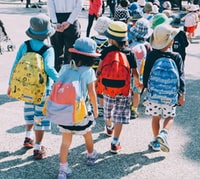 These are different realities for kids depending on which part of the world, which part of the country, or which part of the city they live in. In the developing world, the problems relating to commuting to school are numerous ranging from a low number of Schools in rural areas vs urban areas leading to long distance to/from schools, a lack of or poor road infrastructure, poverty leading to lack of personal mean of transportation, and danger on the way to school (worse for girls).
Solutions have been thought of and implemented with the means at hand, many times by governments, funded by international organizations or their own budget. Other times, temporary or long-term solutions have been designed by private foundations, local community leaders or NGOs.
In some parts of the US, where the road to school has proven unsafe in high crime neighborhood, groups have helped identify safe routes for students to take to and from school. This is the case of cities like Chicago for example. In New Jersey, “walking school buses” have been created, which means children walking to and from school together, chaperoned by an adult.
In Detroit, the MacKinac center for public policies suggested that “Transportation scholarships could help some students select a school that works for them”
A study in Mexico reported that “Riding a bike with someone else – their parent or relative – has become a very common way to get to school,”
In the Philippines, in remote fishing communities not far from Zamboanga city, children who used to go to school by swimming or wading through muddy mangroves, are now using yellow school boats to travel to school, provided through The Yellow Boat of Hope Foundation, co-founded by Jay Jaboneta, a Filipino Blogger. [Read our article about the yellow Boat of Hope Foundation here]
A CNN article that presents different ways kids commute to school around the world, reports that “in the mountains of southwest China’s Sichuan province, a steel ladder was constructed against an 800-meter bluff that children climbed to reach their boarding school in the isolated clifftop village of Atule’er”.
All over the world, people, communities, and organizations are working hard to make a difference into the lives of the most disadvantageous in Education and other areas. If you are doing the same in your community, we would love to hear from you and share your story. Please write to us with your story at voice@dorcasmanou.com
Dorcas Manou-Assoko
Leave A Comment
Your email address will not be published. Required fields are marked.