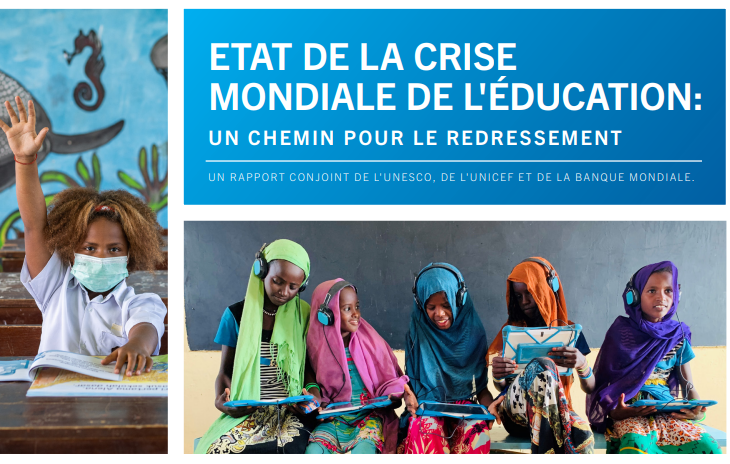
The State of the Global Education Crisis: A Path to Recovery
This post is also available in:
« The COVID-19 pandemic has caused an unprecedented disruption in education, with serious impacts on learning “The COVID-19 pandemic has caused unprecedented disruption in education, with severe implications for learning. The crisis has crippled education systems around the world, and school closures have affected more than 1.6 billion learners… “. The global learning crisis has proven to be even bigger than feared: Due to school closures, the current generation of students now stands to lose US$17 trillion in lifetime earnings, equivalent to 14% of global GDP current and much more than the estimated US$10 trillion in 2020. »
Here is the alarming observation made by the World Bank, Unesco and UNICEF of the unprecedented crisis in Education around the world, in this joint report at the end of 2021, almost two years after a pandemic which seems to be never ending. While the situation is severe in developed countries, it is dire in low- and middle-income countries where the percentage of children whose learning is affected – which was already over 50% before the pandemic (pre-pandemic poverty of learning) – would soon appear to reach almost 70% due to the prolonged closure of schools that affects the quality of education. What a disaster!
See for yourself the effects of this crisis, listed below:
- The already very deep inequalities in the field of Education have worsened:
Be it from the perspective of the countries where the children live (rich countries or poorer countries), or from the perspective of the level of income of families within the same country, the consequences of several months of school closures marked the education of children around the world in a different way.
While developed countries have been able to put in place effective distance education systems, and targeted interventions to maintain the level of education of children studying from home regardless of their origin or social class, the level of income of families in developing countries has been a determining factor in maintaining the quality of learning, in a context where school closures have lasted longer than in developed countries.
- Progress for children and young people in areas interconnected with education, such as health, social protection or gender equality, has stagnated or reversed.
In low- and middle-income countries, where schools are a salutary escape for children and young people, closed schools mean children and young people are more at risk of starving (as school canteens are closed), being subject to domestic work, family violence or early marriage, and therefore not being able to return to school (especially for young girls), thus widening the gap of gender inequalities, and social inequalities.
Faced with this catastrophic state of crisis for young people and children in developing countries, this report presents possible solutions and recommendations to governments, highlighting how states can take advantage of opportunities for innovation and transformation that emerged during the state of emergency created by the pandemic.
In this report, an opportunity is given to states to learn lessons from the pandemic, and to build on innovative education strategies put in place here and there by several countries.
This report is rich in data, lessons and strategies, and could be a valuable tool for any government that wants to be inspired to take action.
This is the time for the governments of low- and middle-income countries to realize the urgency of acting, to think long term, and to put in place exit strategies from this education crisis towards the establishment recovery plans for their education systems, in order to strengthen them and make them resilient. There is no other alternative than education for the countries of sub-Saharan Africa, for example, where the majority of the population is young.
Access the Executive Summary here: World Bank Document
Access the full report here: The State of the Global Education Crisis: A Path to Recovery
D. Manou-Assoko
Leave A Comment
Your email address will not be published. Required fields are marked.